by Wendy Murray
Saint Francis de Sales (1567 – 1622), was a French bishop whose views about "holy imagination" redefined devotion in his time, especially as it is expressed in the arts. His wisdom is timeless and serves as an apt guide for those in the literary realm whose writing voice also possesses spiritual sensibilities.
His book Finding God Wherever You Are offers helpful lessons for writers and artists of any time who find themselves entrenched in the struggles of the human situation:
1. Make decisions and then act. "Our spirit should give vent whole-heartedly to these good movements of the will . . . But do not linger too long with general movements of the will. You have to change them into deliberate decisions."
2. Stay honorable. "The really patient servant of God bears equanimity of the humiliating trials as well as the honorable."
3. Small mistakes at the beginning only grow larger if left unchecked: "Small mistakes made at the beginning of any project grown infinitely great as it progress . . . . Hence, you should know, before everything else, what is the virtue of devotion."
4. Protect your environment: "Nothing calms down an angry elephant so quickly as a the sight of a little lamb, and nothing breaks the force of cannon balls so easily as wool."
5. Think through projects carefully, choose them clear-headedly, and stay the course. "We are not to question our choice, but devotedly, calmly, steadfastly keep it up, carry it through. Although difficulties, temptations and many different things may beset our path, to make us wonder if we have done right, we are to remain resolute and take no notice . . . . Once our decision has been taken with God's help, we need never fear but that God will aid us to carry it through."
Other books by Frances de Sales include:
The Art of Loving God
Finding God's Will for You
Introduction to the Devout Life
(See Plogger's Pope Francis' call to be Digital Citizens, Message for the memorial service of Saint Frances de Sales)
Showing posts with label Writing Advice. Show all posts
Thursday, January 23, 2014
Tuesday, January 21, 2014
Advice to Writers from a Modern Classic: William Langewiesche
By Wendy Murray
William Langewiesche, best-selling author, international correspondent for Vanity Fair, and (it so happens) a pilot, won the rare honor of being chosen by the editors of Penguin Modern Classics (U.K.) to publish a volume of his writings about flight, thus joining the ranks of George Orwell, Evelyn Waugh, Albert Camus, Italo Calvino, Capote, Steinbeck and Gandhi.
Titled Aloft (Feb 2010), Penguin chose the topic of flight from Langewiesche’s writing corpus because, says PMC-U.K. editor Helen Conford, “William possesses a unique perspective on flight and his writing is almost poetic in the way it captures the first century of flight.” It is “a rare event” that a living writer should be numbered among other classic (deceased) authors. “PMC publishes only those authors whose writing they believe will be recognized in a hundred years’ time,” says Conford.
Langewiesche's approach to writing is a matter of "connecting the dots," getting on the ground, sniffing out the story, "going from Point A to Point B, and taking as long as it takes."
“I could write about anything,” he says. We were sharing a meal at a pub and he points to a red bucket perched slightly to the left outside the door. “I could write a story about that red bucket. Why is it red? What is its diameter? Why does it carry two parallel ridges around its circumference? What is its metallic composition? Tin? Who made it? Why does he make buckets? Is he a peasant-tycoon--you know, a regular guy who doesn’t give a shit about superficiality? They get to the inner essence of things--the stuff you find in junkyards.”
On another occasion I overheard him giving writing advice to his assistant by phone.
On using the first person:
“If first person relates to what you are feeling, drop it out. No one’s concerned about you. Use the first person naturally, but never about yourself.”
On length:
“You’re not going too long. Go long. Make it 30,000 words. We’ll cut it later. Go long. Go long. Just tell the story. Grab the reader by the balls."
On fact-checkers
“Forget the brackets. Why burden the reader with the fact-checker neurosis? I don’t write for fact-checkers."
About his writing process:
I'm a writer. Even when I was a pilot I was a writer. I read an enormous amount of material on what I'm working on but I never take notes on what I read. I don't even underline anymore. I just read and allow myself to forget what is naturally forgotten and remember what I remember. I feel no obligation to cite anything. I like my prose unburdened with apparatus. I take relatively few notes. I listen carefully. I like to use a recorder because it adds the ability to revisit things in a way taking notes doesn't. It's not a crutch, though it's a pain in the ass. I also prefer to do my own research. It makes my work less encyclopedic.
- The American version of Aloft, available at Amazon, etc.
I see writing as highly tactile, like sculpting, forming something, smoothing it with hand strokes. Where before there was nothing, in the end there is a sculpture, an object. Occasionally it doesn't happen that way, either because of my own inability or because I don't have the right subject matter. You can get stuck with an overly linear, overly complex, overly generalized text—all kinds of overlys—that can screw up the aesthetic of a piece. At the same time, I hate aesthetics for aesthetics sake. That is a form of masturbation. Rule number one in writing is Don't Insult the Reader. It's a great insult to a reader to waste reading time. You have this very precious relationship with each reader, and that reader is probably smarter than I am.
Monday, January 13, 2014
5 Tips for Developing Good Reading Habits
It is wondrous to enjoy the life-giving and grounding habit of becoming a reader. It is an excellent adventure! Here are some helpful tips:
1. Pace yourself. Each book has its own process of discovery and interior animation.
2. Overthrow distractions. There will always be something else you can do. But, upon my word, remember: reading is doing something. It is feeding the mind and expanding soul at the same time.
3. Give yourself permission to find which genre animates you, then delve into it. Also, simply because a friend says a book was "the best book I've read" and has lent it to you does not mean it will be the best you have ever read. You are not obliged to like what other people like. In any case, please remember to return the loaned book!
4. Alternate reading between new offerings and proven classics. Time is the true test of all good writing.
5. Get a good chair or a comfy couch with a solid end table (where you will stack your books) and good lighting. This is your happy place.
Slow down. Pick up a good book.
Sunday, January 12, 2014
Best of the Week, Jan 6 to 12 ~ Writing Advice, Amanda Knox & Crossing the Rubicon
In case you missed our postings last week, here are the highlights. The days are getting longer!
The Amanda Knox Verdict
Trust the Process: Another Verdict Looms for Amanda Knox: The Italian court system, though different than that of the U.S., is competent. We must trust the process.
Writing Advice
Writing Advice: 5 Reality Checks for Aspiring Writers: Keeping working even if the market is capricious. Ultimately, staying power defines the writer who succeeds.
Julius Caesar Crossing the Rubicon
The Die Is Cast: Eternal Rome and the Crossing of the Rubicon: The metaphor, "to cross the Rubicon," means to take a decisive and irrevocable step that commits one to a specific course, come what may.
The Amanda Knox Verdict
Trust the Process: Another Verdict Looms for Amanda Knox: The Italian court system, though different than that of the U.S., is competent. We must trust the process.
Writing Advice
Writing Advice: 5 Reality Checks for Aspiring Writers: Keeping working even if the market is capricious. Ultimately, staying power defines the writer who succeeds.
Julius Caesar Crossing the Rubicon
The Die Is Cast: Eternal Rome and the Crossing of the Rubicon: The metaphor, "to cross the Rubicon," means to take a decisive and irrevocable step that commits one to a specific course, come what may.
Labels:
Amanda Knox,
Ancient History,
Journalism,
Writing Advice
Thursday, January 9, 2014
Writing Advice from the Writer of the Stars: Tom Junod
By Wendy Murray
(This piece appeared first on Tumblr, in a blog that has been deleted.)
Tom Junod’s Esquire cover story (Dec.) on George Clooney created a buzz, not because it was by Tom Junod, but because of what Clooney said about Russell Crowe and Twitter, among other things. When the buzz commenced, before seeing the piece, I knew instantly that 1. if it was a cover story on Clooney and 2. in Esquire — and 3. that it was buzzing — it was written by Tom Junod.
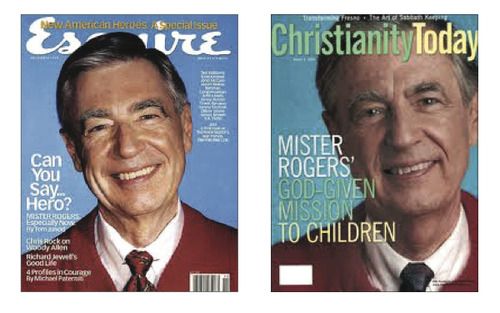
Our careers intersected years ago in the person of Fred (Mister) Rogers. Writing a piece about Fred was where we both went as journalists when we needed some reorientation or recalibrating of who we are.
Fred said to me repeatedly during that assignment, “Oh Wendy, do call Tom. He is such a wonderful man.” Fred Rogers died in 2003. Tom and I both felt the loss deeply. Fred brought us together as friends and colleagues who speak truth to each other. (There is no place else to go when your starting point is Mister Rogers.)
I spoke with Tom at length not long ago for a book I am writing. It was a compelling and intimate conversation that reveals that, behind the Clooney buzz, he is a writer with a profound sense of his humanity.
I include a few glimpses of that conversation below:
On his father [whom he likens to “Don Draper” of Mad Men]
I couldn’t watch certain TV shows. I couldn’t watch The Monkees or The Flying Nun. His problem with The Flying Nun was that he thought it was sacreligious, even though he was a heathen and never went to church. And his problem with The Monkees was that [when] he used to go to night clubs in New York City, El Morocco and Copacabana — he was big on that world; he lived like a wannabe star and wannabe gangster at the same time — he had heard in his travels that one of the Monkees was gay. I was 8 or something and I wasn’t allowed to watch The Monkees because one of them apparently was a homosexual.
On journalism & an oddly disorienting childhood
The journalists that I like the most have that in common. The guys that I know the best are the Esquire guys, the crowd of guys I came up with. All of us have a lot of that in common. We kind of stumbled our way into it. I value those voices more than I value than the people who are trying to make journalism one-of-the-professions crowd.
On William Faulkner
Faulkner’s writing was like the-whole-word-in-a-sentence kind of thing. He would write these endless sentences, marching up and down with words I didn’t know (I had to look them up in a dictionary). The whole idea of putting a world in a sentence seemed to appeal to me right away. And it still does.
When I started reading literature I found people who finally had their say in ways that were consummate and unimpeachable and complete.
That is still part of me as a writer. I tend to write long. I tend to write in paragraphs rather than in sentences. That desire to have my say has been with me since I was a kid. Journalism allowed me that and I’m happy for it.
On Fred ‘Mister’ Rogers [The assignment came in the bruising aftermath of the publication of a piece Tom had written a controversial piece about Kevin Spacey]
There was an editor at Esquire that had the idea of me doing a piece on Mister Rogers based on the logic: Wouldn’t it be funny for Tom, the bad boy now, this take-no-prisoners guy, to go and interview Mister Rogers?
Then I went in and saw Fred. And Fred, in his way, decided to trust me in a open way and strategic way, in a way that let me know that he knew that I needed to be trusted. Fred Rogers had a way of looking at people — it was a minister’s way of looking at people — knowing what they needed. And Fred trusted me. I wrote about that when I wrote about Fred.
I had come to a difficult moment in my career. I was really having trouble writing and figuring out what was expected of me — was I supposed to be the good guy? Was I supposed to be the bad guy? Am I wearing black? Am I wearing white? All this extra-journalistic stuff or non-journalistic stuff was entering into my journalism. Then Fred came along and offered me this trust. It was an amazing experience.
A moment of grace
I was not looking for a moment of grace. I came in there thinking, Isn’t this funny that Tom, the guy who can tear the skin off of somebody’s back, is going to do a piece on gentle Fred?
I spent a lot of time with Fred. Bill Eisler [Fred’s agent] and I were driving to Fred’s hometown of Latrobe the day we went to Fred’s parents’ graveside. On the way down Bill said:
‘You know what’s happening here, don’t you?’
I said, ‘no.’
He said, ‘Fred’s interested in you spiritually.’
I said, ‘Really?’
He said, ‘Do you really think Fred spends time like this with people? Fred doesn’t do anything he doesn’t want to do.’
Under that gentle voice is a man of steel. Bill was very clear about that. Fred does not do anything he does not want to do.
Fred definitely had a spiritual agenda that I did not have. I have had moments of desperation as a writer and I was desperate about writing at that time. Writing doesn’t come easily to me. When things are working I can write well and I can write long. But when they aren’t I am practically illiterate.
I’ve been trying to move towards being honest with people and having a human experience with people. It’s such a large part of the job. To have people trust you and believe is a profound thing. The fact that I’ve become friendly with certain people that I’ve written about is important to me. It never used to be. I used to be kind of a scorched-earth person. I think that is a younger man’s game. As you get older you realize that it is not worth having somebody call you a liar or having somebody say you betrayed his trust. It is very damaging to me and damning to me.
In my piece about Fred I talk about the umbrella opening in my heart [when he prayed]. It was a spiritual moment. But it was also a writing moment. I had a piece that I had to do for Esquire that I was completely jammed on; I couldn’t write it. When I felt my heart open like an umbrella, I knew in that moment that I was going to be able to go back to my hotel room and finish that piece. I felt that certain burdens were lifted.
(This piece appeared first on Tumblr, in a blog that has been deleted.)
Tom Junod’s Esquire cover story (Dec.) on George Clooney created a buzz, not because it was by Tom Junod, but because of what Clooney said about Russell Crowe and Twitter, among other things. When the buzz commenced, before seeing the piece, I knew instantly that 1. if it was a cover story on Clooney and 2. in Esquire — and 3. that it was buzzing — it was written by Tom Junod.
Our careers intersected years ago in the person of Fred (Mister) Rogers. Writing a piece about Fred was where we both went as journalists when we needed some reorientation or recalibrating of who we are.
Fred said to me repeatedly during that assignment, “Oh Wendy, do call Tom. He is such a wonderful man.” Fred Rogers died in 2003. Tom and I both felt the loss deeply. Fred brought us together as friends and colleagues who speak truth to each other. (There is no place else to go when your starting point is Mister Rogers.)
I spoke with Tom at length not long ago for a book I am writing. It was a compelling and intimate conversation that reveals that, behind the Clooney buzz, he is a writer with a profound sense of his humanity.
I include a few glimpses of that conversation below:
On his father [whom he likens to “Don Draper” of Mad Men]
I couldn’t watch certain TV shows. I couldn’t watch The Monkees or The Flying Nun. His problem with The Flying Nun was that he thought it was sacreligious, even though he was a heathen and never went to church. And his problem with The Monkees was that [when] he used to go to night clubs in New York City, El Morocco and Copacabana — he was big on that world; he lived like a wannabe star and wannabe gangster at the same time — he had heard in his travels that one of the Monkees was gay. I was 8 or something and I wasn’t allowed to watch The Monkees because one of them apparently was a homosexual.
On journalism & an oddly disorienting childhood
The journalists that I like the most have that in common. The guys that I know the best are the Esquire guys, the crowd of guys I came up with. All of us have a lot of that in common. We kind of stumbled our way into it. I value those voices more than I value than the people who are trying to make journalism one-of-the-professions crowd.
On William Faulkner
Faulkner’s writing was like the-whole-word-in-a-sentence kind of thing. He would write these endless sentences, marching up and down with words I didn’t know (I had to look them up in a dictionary). The whole idea of putting a world in a sentence seemed to appeal to me right away. And it still does.
When I started reading literature I found people who finally had their say in ways that were consummate and unimpeachable and complete.
That is still part of me as a writer. I tend to write long. I tend to write in paragraphs rather than in sentences. That desire to have my say has been with me since I was a kid. Journalism allowed me that and I’m happy for it.
On Fred ‘Mister’ Rogers [The assignment came in the bruising aftermath of the publication of a piece Tom had written a controversial piece about Kevin Spacey]
There was an editor at Esquire that had the idea of me doing a piece on Mister Rogers based on the logic: Wouldn’t it be funny for Tom, the bad boy now, this take-no-prisoners guy, to go and interview Mister Rogers?
Then I went in and saw Fred. And Fred, in his way, decided to trust me in a open way and strategic way, in a way that let me know that he knew that I needed to be trusted. Fred Rogers had a way of looking at people — it was a minister’s way of looking at people — knowing what they needed. And Fred trusted me. I wrote about that when I wrote about Fred.
I had come to a difficult moment in my career. I was really having trouble writing and figuring out what was expected of me — was I supposed to be the good guy? Was I supposed to be the bad guy? Am I wearing black? Am I wearing white? All this extra-journalistic stuff or non-journalistic stuff was entering into my journalism. Then Fred came along and offered me this trust. It was an amazing experience.
A moment of grace
I was not looking for a moment of grace. I came in there thinking, Isn’t this funny that Tom, the guy who can tear the skin off of somebody’s back, is going to do a piece on gentle Fred?
I spent a lot of time with Fred. Bill Eisler [Fred’s agent] and I were driving to Fred’s hometown of Latrobe the day we went to Fred’s parents’ graveside. On the way down Bill said:
‘You know what’s happening here, don’t you?’
I said, ‘no.’
He said, ‘Fred’s interested in you spiritually.’
I said, ‘Really?’
He said, ‘Do you really think Fred spends time like this with people? Fred doesn’t do anything he doesn’t want to do.’
Under that gentle voice is a man of steel. Bill was very clear about that. Fred does not do anything he does not want to do.
Fred definitely had a spiritual agenda that I did not have. I have had moments of desperation as a writer and I was desperate about writing at that time. Writing doesn’t come easily to me. When things are working I can write well and I can write long. But when they aren’t I am practically illiterate.
I’ve been trying to move towards being honest with people and having a human experience with people. It’s such a large part of the job. To have people trust you and believe is a profound thing. The fact that I’ve become friendly with certain people that I’ve written about is important to me. It never used to be. I used to be kind of a scorched-earth person. I think that is a younger man’s game. As you get older you realize that it is not worth having somebody call you a liar or having somebody say you betrayed his trust. It is very damaging to me and damning to me.
In my piece about Fred I talk about the umbrella opening in my heart [when he prayed]. It was a spiritual moment. But it was also a writing moment. I had a piece that I had to do for Esquire that I was completely jammed on; I couldn’t write it. When I felt my heart open like an umbrella, I knew in that moment that I was going to be able to go back to my hotel room and finish that piece. I felt that certain burdens were lifted.
Monday, January 6, 2014
Writing Advice: 5 Reality Checks for Aspiring Writers
1) Keeping working even if the market is capricious. Ultimately, staying power defines the writer who succeeds.
2) Social networking for book marketing is helpful, but don't fret over it. Facebook is proving less helpful with its recent algorithm protocols, which determine who sees your posts and who doesn't. Twitter is helpful and LinkedIn is robust. In the end your book will stand on its own terms ~ so don't be discouraged if you don't have a FB page or web site. (Follow Eqplogger on Twitter.)
3) For most publishers the bottom line is the bottom line. Unless you've evacuated an airliner by triggering the inflatable emergency slide or won Dancing with the Stars it is best not to quit your day job if you want to publish a book. Save your writing for that sacred space and special time when you give yourself permission to be who you were made to be.
4) Don't try to create a project to be "unlike anything before." What you can do best is your tell your story -- or any story -- in the way only you can tell it. Find your voice, take your time, be compelling.
5) Practice falling off a horse and getting back on a few dozen times. If you're still standing, then you're a writer.
Ecco Qua Press is an independent publisher that upholds the tradition of good writing.
Sunday, January 5, 2014
Writing Advice: Accept the Pacing ~ Umberto Eco on Staying the Course
By Wendy Murray
![]() |
| Umberto Eco, born January 5, 1932 |
At the end of the book, the author included personal advice about both the writing process as well as the reading:". . . . after reading the manuscript, my friends and editors suggested I abbreviate the first hundred pages, which they found difficult and demanding. Without thinking twice, I refused, because, as I insisted, if somebody wanted to the enter the abbey and live there for seven days, he [or she] had to accept the abbey's own pace. If he could not, he would never manage to read the whole book. Therefore those first hundred pages are like a penance or an initiation, and if someone doesn't like them, so much the worse for them. He can stay at the foot of the hill.
Entering a novel is like going on a climb in the mountains: you have to learn the rhythm of respiration, acquire the pace; otherwise you stop right away."
Friday, January 3, 2014
Writing Advice: Courage & Tenacity ~ How Writing Is Like Hunting
Author Steven Rinella, in his book Man Eater, Adventures From the Life of an American Hunter, draws an apt comparison between writing and hunting:
“I worked for a long time to bring this level of patience and tenacity to writing, which can be painfully boring. At its worst, when it’s a seemingly endless string of hours spent waiting for a sensible passage to appear across a computer screen, I recall the silent, lonely and uncomfortable days that I’ve endured in the woods. I imagine that the idea I’m trying to put into words is an elk that’s out of sight but, perhaps, slowly headed my way. In both disciplines, there are things I can do to help bring about the result I want: In the case of hunting, it’s important to maintain silence; in the case of writing, to maintain an incessant clacking of keystrokes. Ultimately, I found that success for each often came down to my ability to endure discomfort and boredom long enough for the desired result to happen along, magically, on its own. And when those moments came, I discovered that the writer and the hunter both need the reflexes and bravery to go in for the kill.”
(The author of three books on hunting. His most recent is “Meat Eater: .” (NYTimes Book Review, July 19 2013)
Subscribe to:
Posts (Atom)