Showing posts with label Contemporary Writers. Show all posts

Friday, February 6, 2015

Alexander Solzhenitsyn Warned the West of Its Tilt Toward Totalinarianism


By Wendy Murray

“When you're cold, don't expect sympathy from someone who's warm.”
― Aleksandr Solzhenitsyn, One Day in the Life of Ivan Denisovich


On February 14 in 1974 authorities in the Soviet Union officially charged writer Alexander Solzhenitsyn (1918 to 2008) with treason. He was sent into exile and his Russian citizenship revoked.

Having publicly criticized totalitarian rule under the Soviet system, his writings were censored and condemned in his homeland, but held up and praised in the West. He raised global awareness of Soviet system of forced labor camps, called the GULAG (the Russian term Glavnoye Upravleniye ispravitelno-trudovyh Lagerey, or "Chief Administration of Corrective Labour Camps") where The Gulag Archipelago (three volumes) and One Day in the Life of Ivan Denisovich.
dissidents went who criticized the system. Solzhenitsyn spent 11 years in the GULAG, documented in his books

(Go here for a list of all his books.)

He was awarded the Nobel Prize in Literature in 1970, "for the ethical force with which he has pursued the indispensable traditions of Russian literature." He was expelled from the Soviet Union in 1974 and took up residency in rural Vermont, but returned to Russia in 1994 after the dissolution of the Soviet Union. He died  in August, 2008.

June 8, 1978, Solzhenitsyn gave the commencement address at Harvard University, called "A World Split Apart" in which he warned that Western nations are as vulnerable to totalitarian rule has the East has been and are in fact becoming inclined to it:

"A decline in courage may be the most striking feature which an outside observer notices in the West in our days. The Western world has lost its civil courage, both as a whole and separately, in each country, each government, each political party, and, of course, in the United Nations. Such a decline in courage is particularly noticeable among the ruling groups and the intellectual elite, causing an impression of loss of courage by the entire society. Of course, there are many courageous individuals, but they have no determining influence on public life."

The video of his address is below: He speaks in Russian with simultaneous translation. The first 2 minutes alone are worth watching as he is introduced and his work put into its historical context. At the time the address was received with mix sentiment, as Solzhenitsyn leveled harsh criticism of Western self-interest and materialism: "The defense of individual rights has reached such extremes as to make society as a whole defenseless against certain individuals. . . . It is time, in the West, to defend not so much human rights as human obligations.”

Tuesday, March 18, 2014

John Updike's Curiosity About Faith & Resonance with J.D. Salinger


Copyright © 2014 Wendy Murray.

By Wendy Murray

John Updike was born on this day, March 18, in 1932 (d. Jan 27, 2009). He is best known for his "Rabbit" series in fiction, two of which won the Pulitzer Prize in Fiction, Rabbit is Rich (1982) and Rabbit at Rest (1991).

Updike's Rabbit novels:
(1960) Rabbit, Run 
(1971) Rabbit Redux 
(1981) Rabbit Is Rich  
(1990) Rabbit At Rest 
(1995) Rabbit Angstrom: The Four Novels  
(2001) Rabbit Remembered (a novella in the collection Licks of Love)

I did not take to Updike's novels -- they seemed more a man's game. But I devoured his essays that New Yorker and elsewhere, particularly those he wrote late in his life when he explored spiritual themes.

In 1961 he wrote a review in the New York Times of his contemporary J.D. Salinger's, book Franny and Zooey. (Prior to its publication as a novel it had appeared as two short stories in the New Yorker.) Even at this ascending phase of Updike's career, he resonated with Salinger's religious exploration in the book embodied in the character of Franny. The story centers around her near- despair: “All I know is I’m losing my mind. I’m just sick of ego, ego, ego. My own and everybody else’s. I’m sick of everybody that wants to get somewhere, do something distinguished and all, be somebody interesting. It’s disgusting--it is, it is.” Her disenchantment incited her to want to pray, but she did not know how to pray. Then she latched onto a little book called the Philokalia, which emphasized the transformative value of repeating the “Jesus Prayer”: Jesus, Son of David, have mercy on me, which Franny began to recite compulsively. The novel explores the shock this induced for those around her, as well as the change it affected in her own soul.

In his review of Salinger's book, Updike wrote:  "Let me say, I am glad he is hopeful. I am one of those -- to do some confessing of my own -- for whom Salinger's work dawned as something of a revelation. I expect that further revelations are to come."

(Salinger died the year to the day following Updike's death, January 27, 2010).


Friday, January 31, 2014

Thomas Merton: "Your Life Is Shaped by the End You Live For."


"On the last day of January, under the sign of the Water Bearer, in the year of the great war, and down the shadow of some French mountains on the border of Spain, I came into the world."

Today is the birthday of contemplative writer and Trappist Monk, Thomas Merton (31 Jan 1915 to 10 Dec 1968). He stands out as among the most influential spiritual writers of the 20th century, being read and respected by Catholics, Protestants and members of other faith communities.

Thomas Merton ~ Conversion

He was raised by parents who were artists and experimental intellectually, and thus came of age under the influence of avant-garde intellectualism, sympathizing with heady notions such as Communism. After a wild and tumultuous youth that included fathering a child out of wedlock, Merton converted to Catholicism while attending Columbia University. In December of 1941 he entered the Abbey of Gethsemani, near Bardstown, Kentucky -- a community of monks belonging to the Order of Cistercians of the Strict Observance (Trappists) taking the name Frater Louis. Thereafter he spent the rest of days writing what have now been deemed spiritual classics on topics such as solitude, contemplative prayer and spiritual direction.


Thomas Merton ~ Ongoing Appeal

Merton's works reflect his personal struggles as well as the struggles of the age in which he lived, both spiritual and cultural. Yet, book sales and the ongoing popularity of his writing suggest his sensibilities transcend culture and situation. They have resonated, and continue to resonate, with thinkers and spiritual seekers of all backgrounds and situations, and he remains one of the most widely read and written about spiritual figures of the modern times.

Merton died tragically by accidental electrocution while traveling in Asia in 1968.

Thomas Merton ~ Quotes

Some quotes from Thoughts in Solitude:

"If you want to have a spiritual life you must unify your life . . . . Your life is shaped by the end you live for."

"What is the use of praying if at the very moment of prayer, we have so little confidence in God that we are busy planning our own kind of answer to prayer?"

"Before we can surrender ourselves we must become ourselves."

"This then is our desert: to live facing despair, but not to consent. To trample it down under the hope of the Cross. To wage war against despair unceasingly. That war is our wilderness. If we wage it courageously, we will find Christ on our side."


Other writings include The Seven Storey Mountain, Contemplative Prayer, Life of Holiness

He is the author of more than seventy books that include poetry, personal journals, collections of letters, social criticism, and writings on peace, justice, and ecumenism.

Thomas Merton ~ A Prayer

A Prayer of Thomas Merton, from Thoughts in Solitude:
"I have found and have known, by Your great mercy, that the love of a man's heart that is abandoned and broken and poor is most pleasing to You and attracts the gaze of Your pity, and that it is Your desire and Your consolation, O my Lord, to be very close to those love You and call upon You as their Father. That You may have no greater 'consolation' than to console Your afflicted children and those who come to You poor and empty-handed with nothing but their humanness and their limitation and great trust in your mercy. Amen."


Wednesday, January 22, 2014

Absolution: The Power of Words


"The pressure disappeared with the first word he put on paper.  He thought--while his hand moved rapidly--what a power there was in words; later, for those who heard them, but first for the one who found them; a healing power, absolution, like the breaking of a barrier.  He thought, perhaps the basic secret the scientists have never discovered, the first fount of life, is that which happens when a thought takes shape in words."

Thursday, January 9, 2014

Writing Advice from the Writer of the Stars: Tom Junod

By Wendy Murray
(This piece appeared first on Tumblr, in a blog that has been deleted.)


Tom Junod’s Esquire cover story (Dec.) on George Clooney created a buzz, not because it was by Tom Junod, but because of what Clooney said about Russell Crowe and Twitter, among other things. When the buzz commenced, before seeing the piece, I knew instantly that 1. if it was a cover story on Clooney and 2. in Esquire — and 3. that it was buzzing — it was written by Tom Junod.

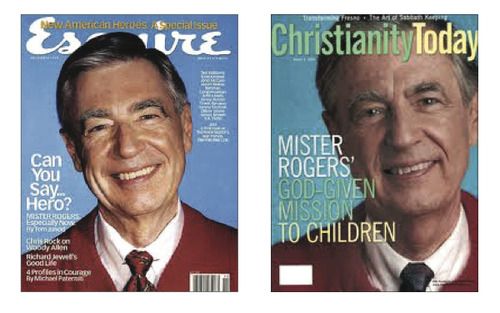
Our careers intersected years ago in the person of Fred (Mister) Rogers. Writing a piece about Fred was where we both went as journalists when we needed some reorientation or recalibrating of who we are.


Fred said to me repeatedly during that assignment, “Oh Wendy, do call Tom. He is such a wonderful man.” Fred Rogers died in 2003. Tom and I both felt the loss deeply. Fred brought us together as friends and colleagues who speak truth to each other. (There is no place else to go when your starting point is Mister Rogers.)

I spoke with Tom at length not long ago for a book I am writing. It was a compelling and intimate conversation that reveals that, behind the Clooney buzz, he is a writer with a profound sense of his humanity.

I include a few glimpses of that conversation below:

On his father [whom he likens to “Don Draper” of Mad Men]
I couldn’t watch certain TV shows. I couldn’t watch The Monkees or The Flying Nun. His problem with The Flying Nun was that he thought it was sacreligious, even though he was a heathen and never went to church. And his problem with The Monkees was that [when] he used to go to night clubs in New York City, El Morocco and Copacabana — he was big on that world; he lived like a wannabe star and wannabe gangster at the same time — he had heard in his travels that one of the Monkees was gay. I was 8 or something and I wasn’t allowed to watch The Monkees because one of them apparently was a homosexual.

On journalism & an oddly disorienting childhood
The journalists that I like the most have that in common. The guys that I know the best are the Esquire guys, the crowd of guys I came up with.  All of us have a lot of that in common. We kind of stumbled our way into it. I value those voices more than I value than the people who are trying to make journalism one-of-the-professions crowd.

On William Faulkner
Faulkner’s writing was like the-whole-word-in-a-sentence kind of thing. He would write these endless sentences, marching up and down with words I didn’t know (I had to look them up in a dictionary). The whole idea of putting a world in a sentence seemed to appeal to me right away. And it still does.

When I started reading literature I found people who finally had their say in ways that were consummate and unimpeachable and complete.

That is still part of me as a writer. I tend to write long. I tend to write in paragraphs rather than in sentences. That desire to have my say has been with me since I was a kid. Journalism allowed me that and I’m happy for it.

On Fred ‘Mister’ Rogers [The assignment came in the bruising aftermath of the publication of a piece Tom had written a controversial piece about Kevin Spacey]

There was an editor at Esquire that had the idea of me doing a piece on Mister Rogers based on the logic: Wouldn’t it be funny for Tom, the bad boy now, this take-no-prisoners guy, to go and interview Mister Rogers?

Then I went in and saw Fred. And Fred, in his way, decided to trust me in a open way and strategic way, in a way that let me know that he knew that I needed to be trusted. Fred Rogers had a way of looking at people — it was a minister’s way of looking at people — knowing what they needed. And Fred trusted me. I wrote about that when I wrote about Fred.

I had come to a difficult moment in my career. I was really having trouble writing and figuring out what was expected of me — was I supposed to be the good guy? Was I supposed to be the bad guy? Am I wearing black? Am I wearing white? All this extra-journalistic stuff or non-journalistic stuff was entering into my journalism. Then Fred came along and offered me this trust. It was an amazing experience.

A moment of grace


I was not looking for a moment of grace. I came in there thinking, Isn’t this funny that Tom, the guy who can tear the skin off of somebody’s back, is going to do a piece on gentle Fred?

I spent a lot of time with Fred. Bill Eisler [Fred’s agent] and I were driving to Fred’s hometown of Latrobe the day we went to Fred’s parents’ graveside. On the way down Bill said:

‘You know what’s happening here, don’t you?’

I said, ‘no.’

He said, ‘Fred’s interested in you spiritually.’

I said, ‘Really?’

He said, ‘Do you really think Fred spends time like this with people? Fred doesn’t do anything he doesn’t want to do.’

Under that gentle voice is a man of steel. Bill was very clear about that. Fred does not do anything he does not want to do.

Fred definitely had a spiritual agenda that I did not have. I have had moments of desperation as a writer and I was desperate about writing at that time. Writing doesn’t come easily to me. When things are working I can write well and I can write long. But when they aren’t I am practically illiterate.

I’ve been trying to move towards being honest with people and having a human experience with people. It’s such a large part of the job. To have people trust you and believe is a profound thing. The fact that I’ve become friendly with certain people that I’ve written about is important to me. It never used to be. I used to be kind of a scorched-earth person. I think that is a younger man’s game. As you get older you realize that it is not worth having somebody call you a liar or having somebody say you betrayed his trust. It is very damaging to me and damning to me.


In my piece about Fred I talk about the umbrella opening in my heart [when he prayed]. It was a spiritual moment. But it was also a writing moment. I had a piece that I had to do for Esquire that I was completely jammed on; I couldn’t write it. When I felt my heart open like an umbrella, I knew in that moment that I was going to be able to go back to my hotel room and finish that piece. I felt that certain burdens were lifted.

Sunday, January 5, 2014

Writing Advice: Accept the Pacing ~ Umberto Eco on Staying the Course

By Wendy Murray

Umberto Eco, born January 5, 1932
Today is the birthday of one of my favorite writers: Italian novelist, Umberto Eco (born1932; he is 82 today). Among other things, he wrote the dazzling mystery novel set in an abbey during 14th-century Italy titled The Name of the Rose.

At the end of the book,  the author included personal advice about both the writing process as well as the reading:

". . . . after reading the manuscript, my friends and editors suggested I abbreviate the first hundred pages, which they found difficult and demanding. Without thinking twice, I refused, because, as I insisted, if somebody wanted to the enter the abbey and live there for seven days, he [or she] had to accept the abbey's own pace. If he could not, he would never manage to read the whole book. Therefore those first hundred pages are like a penance or an initiation, and if someone doesn't like them, so much the worse for them. He can stay at the foot of the hill.
Entering a novel is like going on a climb in the mountains: you have to learn the rhythm of respiration, acquire the pace; otherwise you stop right away."

Best of the Week, Dec 31 - Jan 5

In case you missed our postings last week, here are the highlights. Happy New Year!

8 Lessons Learned About Social Media as Your Workplace Keep going; slow and steady wins the race. Millions compete for internet space. Stay on point; don't freak out. Good content always prevails. . .


Tea with Frederick Buechner: He says, "It was John Updike who said God saves his deepest silence for his saints. Some people might say, 'The hell with it.' His silence throws me back upon myself and I must search my own depths. I'm still searching, aren't you?" He bobs his tea bag. "If we're not searching, we're dead" . . .


The Plaintive Faith of T.S. Eliot: 
. . . No! I am not Prince Hamlet, nor was meant to be;
Am an attendant lord, one that will do
To swell a progress, start a scene or two,
Advise the prince; no doubt, an easy tool,
Deferential, glad to be of use,
Politic, cautious, and meticulous;
Full of high sentence, but a bit obtuse;
At times, indeed, almost ridiculous--
Almost, at times, the Fool.

Saturday, January 4, 2014

The Plaintive Faith of T. S. Eliot

Image Copyright©WendyMurray2014.
 All rights reserved.


Poet T.S. Eliot (1888 to 1965) died on this day, January 4, in 1965. Best known for the poem The Waste Land (1915), Eliot is considered a ground-breaking poet that changed the rules of modern poetry through the imagination and restraint he brought to this work.


(Listen to Eliot reading The Waste Land:)


He possessed a singularity of vision that captured the tension between the ballast of faith and the plaintive uncertainties of human experience. A sense of it is captured in this portion of the poem The Love Song of J. Alfred Prufrock (1915):


And would it have been worth it, after all,
Would it have been worth while,
After the sunsets and the dooryards and the sprinkled streets,
After the novels, after the teacups, after the skirts that trail along the floor--
And this, and so much more?--
It is impossible to say just what I mean!
But as if a magic lantern threw the nerves in patterns on a screen:
Would it have been worth while
If one, settling a pillow or throwing off a shawl,
And turning toward the window, should say:
"That is not it at all,
That is not what I meant, at all."

No! I am not Prince Hamlet, nor was meant to be;
Am an attendant lord, one that will do
To swell a progress, start a scene or two,
Advise the prince; no doubt, an easy tool,
Deferential, glad to be of use,
Politic, cautious, and meticulous;
Full of high sentence, but a bit obtuse;
At times, indeed, almost ridiculous--
Almost, at times, the Fool.