Showing posts with label American Writers. Show all posts

Friday, January 31, 2014

Thomas Merton: "Your Life Is Shaped by the End You Live For."


"On the last day of January, under the sign of the Water Bearer, in the year of the great war, and down the shadow of some French mountains on the border of Spain, I came into the world."

Today is the birthday of contemplative writer and Trappist Monk, Thomas Merton (31 Jan 1915 to 10 Dec 1968). He stands out as among the most influential spiritual writers of the 20th century, being read and respected by Catholics, Protestants and members of other faith communities.

Thomas Merton ~ Conversion

He was raised by parents who were artists and experimental intellectually, and thus came of age under the influence of avant-garde intellectualism, sympathizing with heady notions such as Communism. After a wild and tumultuous youth that included fathering a child out of wedlock, Merton converted to Catholicism while attending Columbia University. In December of 1941 he entered the Abbey of Gethsemani, near Bardstown, Kentucky -- a community of monks belonging to the Order of Cistercians of the Strict Observance (Trappists) taking the name Frater Louis. Thereafter he spent the rest of days writing what have now been deemed spiritual classics on topics such as solitude, contemplative prayer and spiritual direction.


Thomas Merton ~ Ongoing Appeal

Merton's works reflect his personal struggles as well as the struggles of the age in which he lived, both spiritual and cultural. Yet, book sales and the ongoing popularity of his writing suggest his sensibilities transcend culture and situation. They have resonated, and continue to resonate, with thinkers and spiritual seekers of all backgrounds and situations, and he remains one of the most widely read and written about spiritual figures of the modern times.

Merton died tragically by accidental electrocution while traveling in Asia in 1968.

Thomas Merton ~ Quotes

Some quotes from Thoughts in Solitude:

"If you want to have a spiritual life you must unify your life . . . . Your life is shaped by the end you live for."

"What is the use of praying if at the very moment of prayer, we have so little confidence in God that we are busy planning our own kind of answer to prayer?"

"Before we can surrender ourselves we must become ourselves."

"This then is our desert: to live facing despair, but not to consent. To trample it down under the hope of the Cross. To wage war against despair unceasingly. That war is our wilderness. If we wage it courageously, we will find Christ on our side."


Other writings include The Seven Storey Mountain, Contemplative Prayer, Life of Holiness

He is the author of more than seventy books that include poetry, personal journals, collections of letters, social criticism, and writings on peace, justice, and ecumenism.

Thomas Merton ~ A Prayer

A Prayer of Thomas Merton, from Thoughts in Solitude:
"I have found and have known, by Your great mercy, that the love of a man's heart that is abandoned and broken and poor is most pleasing to You and attracts the gaze of Your pity, and that it is Your desire and Your consolation, O my Lord, to be very close to those love You and call upon You as their Father. That You may have no greater 'consolation' than to console Your afflicted children and those who come to You poor and empty-handed with nothing but their humanness and their limitation and great trust in your mercy. Amen."


Tuesday, January 21, 2014

Advice to Writers from a Modern Classic: William Langewiesche

By Wendy Murray
William Langewiesche, best-selling author, international correspondent for Vanity Fair, and (it so happens) a pilot,  won the rare honor of being chosen by the editors of Penguin Modern Classics (U.K.) to publish a volume of his writings about flight, thus joining the ranks of George Orwell, Evelyn WaughAlbert Camus,  Italo Calvino, Capote, Steinbeck and Gandhi.
Titled Aloft  (Feb 2010), Penguin chose the topic of flight from Langewiesche’s writing corpus because, says PMC-U.K. editor Helen Conford, “William possesses a unique perspective on flight and his writing is almost poetic in the way it captures the first century of flight.” It is “a rare event” that a living writer should be numbered among other classic (deceased) authors.  “PMC publishes only those authors whose writing they believe will be recognized in a hundred years’ time,” says Conford.
Langewiesche's approach to writing is a matter of "connecting the dots," getting on the ground, sniffing out the story, "going from Point A to Point B, and taking as long as it takes."
“I could write about anything,” he says.  We were sharing a meal at a pub and he points to a red bucket perched slightly to the left outside the door. “I could write a story about that red bucket. Why is it red? What is its diameter? Why does it carry two parallel ridges around its circumference? What is its metallic composition? Tin? Who made it? Why does he make buckets? Is he a peasant-tycoon--you know, a regular guy who doesn’t give a shit about superficiality? They get to the inner essence of things--the stuff you find in junkyards.”
On another occasion I overheard him giving writing advice to his assistant by phone.
William Langewiesche
On using the first person:
“If first person relates to what you are feeling, drop it out. No one’s concerned about you. Use the first person naturally, but never about yourself.”
On length:
“You’re not going too long. Go long. Make it 30,000 words. We’ll cut it later. Go long. Go long. Just tell the story. Grab the reader by the balls."
On fact-checkers
“Forget the brackets. Why burden the reader with the fact-checker neurosis? I don’t write for fact-checkers."
About his writing process:
I'm a writer. Even when I was a pilot I was a writer. I read an enormous amount of material on what I'm working on but I never take notes on what I read. I don't even underline anymore. I just read and allow myself to forget what is naturally forgotten and remember what I remember. I feel no obligation to cite anything. I like my prose unburdened with apparatus. I take relatively few notes. I listen carefully. I like to use a recorder because it adds the ability to revisit things in a way taking notes doesn't. It's not a crutch, though it's a pain in the ass. I also prefer to do my own research. It makes my work less encyclopedic.
The American version of Aloft,  available at Amazon, etc.
I see writing as highly tactile, like sculpting, forming something, smoothing it with hand strokes. Where before there was nothing, in the end there is a sculpture, an object. Occasionally it doesn't happen that way, either because of my own inability or because I don't have the right subject matter. You can get stuck with an overly linear, overly complex, overly generalized text—all kinds of overlys—that can screw up the aesthetic of a piece. At the same time, I hate aesthetics for aesthetics sake. That is a form of masturbation. Rule number one in writing is Don't Insult the Reader. It's a great insult to a reader to waste reading time. You have this very precious relationship with each reader, and that reader is probably smarter than I am.

Thursday, January 9, 2014

Writing Advice from the Writer of the Stars: Tom Junod

By Wendy Murray
(This piece appeared first on Tumblr, in a blog that has been deleted.)


Tom Junod’s Esquire cover story (Dec.) on George Clooney created a buzz, not because it was by Tom Junod, but because of what Clooney said about Russell Crowe and Twitter, among other things. When the buzz commenced, before seeing the piece, I knew instantly that 1. if it was a cover story on Clooney and 2. in Esquire — and 3. that it was buzzing — it was written by Tom Junod.

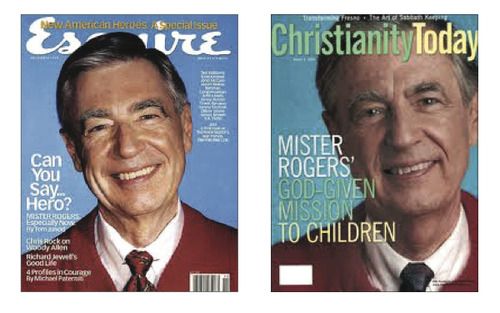
Our careers intersected years ago in the person of Fred (Mister) Rogers. Writing a piece about Fred was where we both went as journalists when we needed some reorientation or recalibrating of who we are.


Fred said to me repeatedly during that assignment, “Oh Wendy, do call Tom. He is such a wonderful man.” Fred Rogers died in 2003. Tom and I both felt the loss deeply. Fred brought us together as friends and colleagues who speak truth to each other. (There is no place else to go when your starting point is Mister Rogers.)

I spoke with Tom at length not long ago for a book I am writing. It was a compelling and intimate conversation that reveals that, behind the Clooney buzz, he is a writer with a profound sense of his humanity.

I include a few glimpses of that conversation below:

On his father [whom he likens to “Don Draper” of Mad Men]
I couldn’t watch certain TV shows. I couldn’t watch The Monkees or The Flying Nun. His problem with The Flying Nun was that he thought it was sacreligious, even though he was a heathen and never went to church. And his problem with The Monkees was that [when] he used to go to night clubs in New York City, El Morocco and Copacabana — he was big on that world; he lived like a wannabe star and wannabe gangster at the same time — he had heard in his travels that one of the Monkees was gay. I was 8 or something and I wasn’t allowed to watch The Monkees because one of them apparently was a homosexual.

On journalism & an oddly disorienting childhood
The journalists that I like the most have that in common. The guys that I know the best are the Esquire guys, the crowd of guys I came up with.  All of us have a lot of that in common. We kind of stumbled our way into it. I value those voices more than I value than the people who are trying to make journalism one-of-the-professions crowd.

On William Faulkner
Faulkner’s writing was like the-whole-word-in-a-sentence kind of thing. He would write these endless sentences, marching up and down with words I didn’t know (I had to look them up in a dictionary). The whole idea of putting a world in a sentence seemed to appeal to me right away. And it still does.

When I started reading literature I found people who finally had their say in ways that were consummate and unimpeachable and complete.

That is still part of me as a writer. I tend to write long. I tend to write in paragraphs rather than in sentences. That desire to have my say has been with me since I was a kid. Journalism allowed me that and I’m happy for it.

On Fred ‘Mister’ Rogers [The assignment came in the bruising aftermath of the publication of a piece Tom had written a controversial piece about Kevin Spacey]

There was an editor at Esquire that had the idea of me doing a piece on Mister Rogers based on the logic: Wouldn’t it be funny for Tom, the bad boy now, this take-no-prisoners guy, to go and interview Mister Rogers?

Then I went in and saw Fred. And Fred, in his way, decided to trust me in a open way and strategic way, in a way that let me know that he knew that I needed to be trusted. Fred Rogers had a way of looking at people — it was a minister’s way of looking at people — knowing what they needed. And Fred trusted me. I wrote about that when I wrote about Fred.

I had come to a difficult moment in my career. I was really having trouble writing and figuring out what was expected of me — was I supposed to be the good guy? Was I supposed to be the bad guy? Am I wearing black? Am I wearing white? All this extra-journalistic stuff or non-journalistic stuff was entering into my journalism. Then Fred came along and offered me this trust. It was an amazing experience.

A moment of grace


I was not looking for a moment of grace. I came in there thinking, Isn’t this funny that Tom, the guy who can tear the skin off of somebody’s back, is going to do a piece on gentle Fred?

I spent a lot of time with Fred. Bill Eisler [Fred’s agent] and I were driving to Fred’s hometown of Latrobe the day we went to Fred’s parents’ graveside. On the way down Bill said:

‘You know what’s happening here, don’t you?’

I said, ‘no.’

He said, ‘Fred’s interested in you spiritually.’

I said, ‘Really?’

He said, ‘Do you really think Fred spends time like this with people? Fred doesn’t do anything he doesn’t want to do.’

Under that gentle voice is a man of steel. Bill was very clear about that. Fred does not do anything he does not want to do.

Fred definitely had a spiritual agenda that I did not have. I have had moments of desperation as a writer and I was desperate about writing at that time. Writing doesn’t come easily to me. When things are working I can write well and I can write long. But when they aren’t I am practically illiterate.

I’ve been trying to move towards being honest with people and having a human experience with people. It’s such a large part of the job. To have people trust you and believe is a profound thing. The fact that I’ve become friendly with certain people that I’ve written about is important to me. It never used to be. I used to be kind of a scorched-earth person. I think that is a younger man’s game. As you get older you realize that it is not worth having somebody call you a liar or having somebody say you betrayed his trust. It is very damaging to me and damning to me.


In my piece about Fred I talk about the umbrella opening in my heart [when he prayed]. It was a spiritual moment. But it was also a writing moment. I had a piece that I had to do for Esquire that I was completely jammed on; I couldn’t write it. When I felt my heart open like an umbrella, I knew in that moment that I was going to be able to go back to my hotel room and finish that piece. I felt that certain burdens were lifted.

Saturday, January 4, 2014

The Plaintive Faith of T. S. Eliot

Image Copyright©WendyMurray2014.
 All rights reserved.


Poet T.S. Eliot (1888 to 1965) died on this day, January 4, in 1965. Best known for the poem The Waste Land (1915), Eliot is considered a ground-breaking poet that changed the rules of modern poetry through the imagination and restraint he brought to this work.


(Listen to Eliot reading The Waste Land:)


He possessed a singularity of vision that captured the tension between the ballast of faith and the plaintive uncertainties of human experience. A sense of it is captured in this portion of the poem The Love Song of J. Alfred Prufrock (1915):


And would it have been worth it, after all,
Would it have been worth while,
After the sunsets and the dooryards and the sprinkled streets,
After the novels, after the teacups, after the skirts that trail along the floor--
And this, and so much more?--
It is impossible to say just what I mean!
But as if a magic lantern threw the nerves in patterns on a screen:
Would it have been worth while
If one, settling a pillow or throwing off a shawl,
And turning toward the window, should say:
"That is not it at all,
That is not what I meant, at all."

No! I am not Prince Hamlet, nor was meant to be;
Am an attendant lord, one that will do
To swell a progress, start a scene or two,
Advise the prince; no doubt, an easy tool,
Deferential, glad to be of use,
Politic, cautious, and meticulous;
Full of high sentence, but a bit obtuse;
At times, indeed, almost ridiculous--
Almost, at times, the Fool.


Thursday, January 2, 2014

Tea with Frederick Buechner

By Wendy Murray

Fred Buechner, photo by Wendy Murray
On Rupert Mountain, Vermont, in May 2002, Frederick Buechner is serving tea, no cream, no sugar. I ask him what he means when he writes frequently about God's silence.

I have traveled to Vermont to meet with him in order to write an article for Christianity Today magazine. We have been chatting for about an hour when he decides it is time for tea. He hands me mine and takes his, settling back into his chair.

He says, "It was John Updike who said God saves his deepest silence for his saints. Some people might say, 'The hell with it.' His silence throws me back upon myself and I must search my own depths. I'm still searching, aren't you?" He bobs his tea bag. "If we're not searching, we're dead."

I tell him his novel The Storm left me sad.

"Oh, I disagree," he says. "I think it ends upbeat."

I say, "It feels like [the protagonist] Kenzie Maxwell simply gives up on his dreams and resigns himself to a life of mediocrity."

He replies, "Why, at the end, all these people come together. The brothers are reconciled. Kenzie stops writing his letters to his dead lover."

“But," I say, "at the end of the book Kenzie is lying alone in his bed, wondering about the crazy saints and if what had driven them crazy was their endlessly trying -- as he was -- to find where they really belonged." -- "Has Kenzie found where he belongs?"

"Maybe not," Buechner says. "But he's come a long way."

The Storm's narrator says (of Kenzie): "He thought of himself as a man who wrote because he couldn't think of anything else to do with his delusions." I ask Buechner what he meant.

"I wish I had said 'illusions'," he says. "Kenzie is a self-deprecating illusionist."

I ask, "Which of your novels would be your seminal work? Godric is as close as you've come to writing in your 'life's blood,' as you say. But I believe you could come closer."

He doesn't disagree. Then he adds, "All of my fiction was written with my life's blood."